Friday, November 30, 2012

Chapter 10: The Southern Coastlands: On the Subtropical Margin


Oil

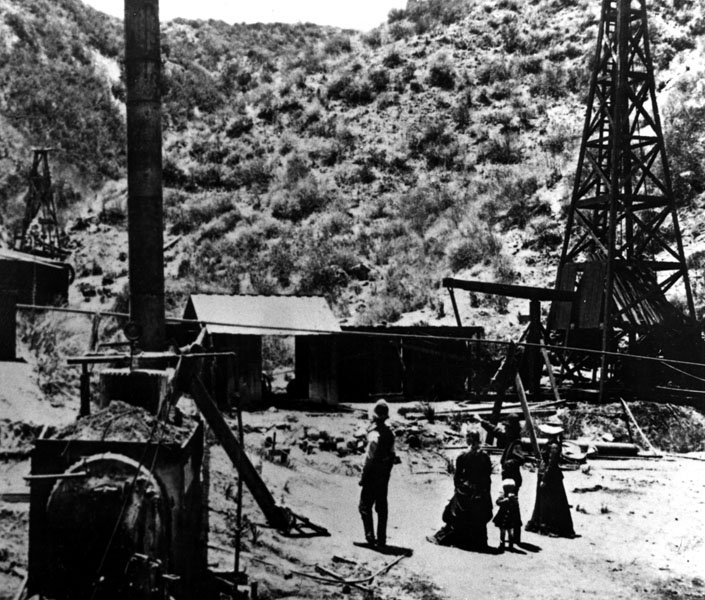
This photo is oil rig drilled in Pico Canyon in the San Fernando Valley near Newhall in 1875.


"In 1916, the San Fernando Valley's first oil well was drilled in what is now Granada Hills. The oil well was located at the northern tip of Zelzah Avenue" (Webcache).


Gas

The prices of gas is pricey comparing to other states. I personally have to fill up gas like 2 tanks per month to go to work, school, and personal errands. I would recommend using an economy friendly car to save on gas expenses.

Below is a list of gas prices in the San Fernando Valley


PriceStationAreaThanks

update
ARCO
1753 Truman St & Hubbard St
San Fernando
3 hours ago

update
76
1601 Truman St & S Lazard St
San Fernando
3 hours ago

update
ARCO
11243 San Fernando Rd & Desmond St
San Fernando
6 hours ago

update
ARCO
11244 Laurel Canyon Blvd & Brand Blvd
San Fernando
21 hours ago

update
Mobil
14666 San Fernando Mission Blvd & Laurel Canyon Bl
San Fernando
1 hour ago

update
76
11550 Laurel Canyon Blvd & Rinaldi St
San Fernando
3 hours ago

update
Chevron
11221 Laurel Canyon Blvd & Chatsworth Dr
San Fernando
7 hours ago

update
Shell
11278 Laurel Canyon Blvd & Brand Blvd
(no diesel)
San Fernando
13 hours ago


******Very Helpful Link*********** For a better update the following link will help you search for the lowest gas price around your area. Enjoy! 


List of Utilities
Thanks to Wikipedia, they provide a very useful list of utilities that the San Fernando Valley uses.

Electricity
Los Angeles Department of Water and Power
Burbank Water and Power
Southern California Edison (serves the city of San Fernando)
Glendale Water and Power

Natural Gas
Southern California Gas Company

Water
Los Angeles Department of Water and Power
Burbank Water and Power
Glendale Water and Power
City of San Fernando
Metropolitan Water District

Phone Service
AT&T Inc.
Verizon

Cable Television
Time Warner Cable

Sanitation
City of Los Angeles
City of San Fernando (Crown Disposal Company)
City of Burbank
City of Glendale


--------------------------------------------------------------------------------------------

Url Sources:


Facts: Based on my living experience.

Thursday, October 11, 2012

Chapter 9: The Changing South

POPULATION


"According to the 2010 San Fernando Valley U.S. Census report, the population of the San Fernando Valley is 1.77 million. Of the population 41.1% were non-Hispanic white, 42.0% were Hispanic or Latino, 3.8% were African Americans and 10.7% were Asian."(Wikipedia, 2012)

Below is a map of California's population. In the San Fernando area, it shows a more concentrated (red/orange) color.

File:California population map.png


RELIGION


"With almost one million Jews, California has the highest number of Jews of any state except New York. Many of these Jews live in the West Los Angeles and San Fernando Valley regions of Los Angeles." (Wikipedia, 2012)

RACE


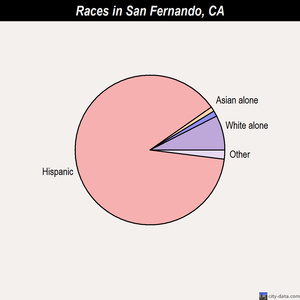
San Fernando races chart


  • Hispanic - 21,867 (92.5%)
  • White alone - 1,259 (5.3%)
  • Asian alone - 192 (0.8%)
  • Black alone - 146 (0.6%)
  • American Indian alone - 66 (0.3%)
  • Two or more races - 82 (0.3%)
  • Native Hawaiian and Other Pacific Islander alone - 19 (0.08%)
  • Other race alone - 14 (0.06%)


  • EXTRA EXTRA! READ ALL ABOUT IT ... 


    Attached below is a great link that breaks down the full statistics on San Fernando's population, crime, household, etc. Enjoy!

    http://www.movoto.com/neighborhood/ca/san-fernando/91340.htm

    http://www.city-data.com/city/San-Fernando-California.html


    --------------------------------------------------------------------------------------------

    Url Sources:


    Picture: http://en.wikipedia.org/wiki/File:California_population_map.png
                 http://www.city-data.com/city/San-Fernando-California.html

    Facts: http://www.movoto.com/neighborhood/ca/san-fernando/91340.htm
              http://en.wikipedia.org/wiki/Demographics_of_California   
              http://www.city-data.com/city/San-Fernando-California.html


    Chapter 8: Appalachia and the Ozarks

    MINING


    Generally in California, there is deep history about the Gold Rush back in 1849, where thousands of mines were discovered. In the San Fernando Valley, you can look for gold and request a map. Attached below is a link to request a gold map. 


    Here is an article from Daily News about the recent mining concern.
    http://www.dailynews.com/news/ci_19658448


    --------------------------------------------------------------------------------------------

    Url Sources:


    Picture: http://la.curbed.com/archives/2012/01/sylmar_residents_dont_want_to_live_below_a_granite_mine.php

    Facts: Links provided above

    Chapter 7: The Bypassed East


    AGRICULTURE


    The San Fernando Valley provides a variety for farming. For example, In Pierce College, there is an agriculture filled with cows, horses, goats, and other animals. There are many fruits and vegetables harvested in the valley such as, alfalfa, beets, lemons, pumpkins, lima beans, olives, and wheat. Also, when I was little, I went on a field trip to go to a harvest festival and planted strawberries under the ground.

    Here is an interesting website regarding the history of agriculture
    http://www.themuseumsfv.org/home-grid/75-agriculture


    --------------------------------------------------------------------------------------------

    Url Sources:


    Picture: http://museumsanfernandovalley.blogspot.com/2012/01/pierce-college-and-valleys-agricultural.html

    Facts: Based on my living experience.

    Chapter 5: The North American Manufacturing Core

    TOURISTS


    Tourists who come around the San Fernando Valley will find this place enjoyable. First, there is Universal Studios, Citi Walk, Six Flags Magic Mountain, and the Japanese Garden.

    Here is an interactive link to look closely at each area of the San Fernando Valley.
    http://thevalley.net/visitors 

    The link below is a guide for tourists to get a brief idea of special places to dine, sleep, shop and more.
    http://www.discoverlosangeles.com/guides/neighborhoods/san-fernando-valley/san-fernando-valley-guide.html

    Below is a map of attractions, venues and shopping destinations.


    CLICK HERE to view a larger map.
    Attractions
    Hotels
    Restaurants
    Bars/Lounges
    Shopping
    Live Theatre
    Golf
    Hiking
    Public Transit
    Airports

    ECONOMY


    There are many different companies that work in the valley. For example, multiple music recording studios, television productions, motion pictures, and big time names including, CBS Studio Center and Warner Bros. Also, there is the famous Walt Disney Company and ABC network.

    Additionally, here is a link in regards to the Economy in the San Fernando Valley


    "The Valley was previously known for advances in aerospace technology and nuclear research by companies such as Lockheed, Rocketdyne and its Santa Susana Field Laboratory, Atomics International, Litton Industries, Marquardt, and TRW's predecessor Thompson Ramo Wooldridge"(Wikipedia, 2012)

    Monday, October 8, 2012

    Chapter 4: Megalopolis


    PUBLIC SERVICES


        Living in the San Fernando Valley provides a plethora of services for residents to enjoy. For example, you have the Public Library, Health care providers such as Kaiser Permanent, Blue Cross Anthem, parks, and public schools. We have different types of authority figures such as police officers, sheriffs, firefighters, EMT, crossing guards, mail mans, places for animal shelters, homeless shelters, soup kitchens and more.

         In the San Fernando valley, the metro line is a great source for transportation. The metro orange line extends from Chatsworth all the way to North Hollywood. Simple prices such as $1.25 for one way and $5.00 for all day. Below is a link for more information on the metro line.
    http://madeinlosangeles.wordpress.com/2012/06/05/valleys-orange-line-bus-extension/


    --------------------------------------------------------------------------------------------

    Url Sources:


    Picture:http://www.newcollegedurham.ac.uk/adult/courses/degreeprogrammes/hepubliccommunityvoluntary/Public%20Services/PublishingImages/public_dest.jpg

    Facts: Based on my living experience.

    Chapter 3: Foundation of Human Activity

    FOUNDATION


    All the information below is credited to the Los Angeles Public Library


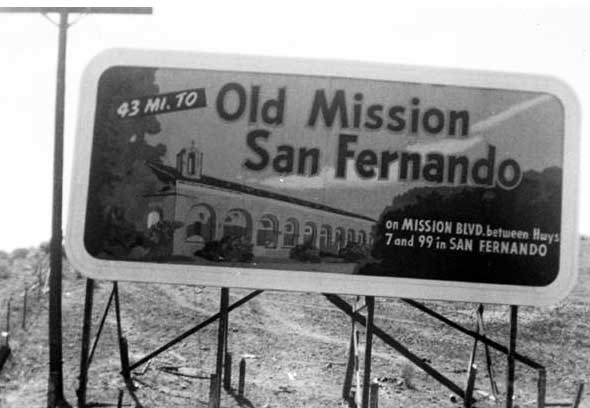
     "San Fernando's first inhabitants were Gabrielino and Tataviam Indians. The first Spanish explorers came through the valley in 1769, led by Gaspar de Portolá on an expedition from San Diego to Monterey the same year that Spain first occupied California. Though a priest named Francisco GarcĂ©s crossed the upper part of the valley in 1776, the area near what is now San Fernando really became settled after a party in 1797 went in search of a new mission on the way to the San Gabriel Mission. They chose a site that Tataviam Indians called Achois Comihabit and that was being run as a ranch by Francisco Reyes, who gave up his interest in the property so the newcomers – Franciscan clergy – could start the San Fernando Mission, the seventeenth mission in the state of California."(County of Los Angeles Public Library, 2012)


         "San Fernando, the oldest city in the valley for which it is named, is located about twenty three miles north of Los Angeles, near the foothills of the San Gabriel Mountains. Founded in 1874, it is nicknamed "The Mission City" because of its proximity to the San Fernando Mission that was established in1797 and on whose former property the city emerged. San Fernando was originally populated by Gabrielino and Tataviam Indians, the latter naming the area "Achois Comihabit," before Spanish explorers first passed through the region in 1769. In its pristine state, the hills and valleys were lush with oak and walnut trees. These gave way to ranches and farms in the nineteenth century, as an outgrowth of activities originally undertaken by the mission which thrived for nearly forty years during the early 1800s. During that time, while California was still Mexican territory, a mixture of Spanish, Indian, and Mexican residents arrived and settled in the valley. Following the mission's secularization in 1834, it went into decline and was abandoned about a decade later."(County of Los Angeles Public Library, 2012)

            "The city's founding in 1874 was spurred by a land boom in Southern California and the Southern Pacific Railroad's building of a rail line between Bakersfield and Los Angeles through Fremont Pass. Soon populated with an influx of settlers, San Fernando became known as the railroad's "gateway to the north," and with its Mediterranean climate and deep wells that provided water for irrigation, the community cultivated an abundance of vegetables and fruits, especially citrus and olives. That independent water supply allowed San Fernando to remain autonomous and incorporate in 1911, while most of the valley's other communities felt compelled to annex to Los Angeles in 1915 to avail themselves of the waters of the Los Angeles Aqueduct, which started flowing in 1913. Today, with a population of about 22,600 people, San Fernando is one of the valley's smaller communities but has retained its individuality and identity with an annual fiesta in celebration of its mission days and downtown architecture that reflects the city's longtime Mexican heritage."(County of Los Angeles Public Library, 2012)


    --------------------------------------------------------------------------------------------

    Url Sources:


    Pictures: http://users.resist.ca/~kirstena/photomissionbillboard.jpg

    Facts: http://www.colapublib.org/history/sanfernando/index.html